What U. S. reading habits mean for publishers | Pew Research Center study
Print dominates, but digital audio gains ground
Published: 5.5.2026 | Foto / Video: AI generated, Magnific
Fresh data from Pew Research Center (read more) shows 75% of U.S. adults read at least one book annually, with print maintaining dominance at 64% while audiobooks and e-books show steady growth –revealing critical insights for publishers navigating format strategy and market positioning.
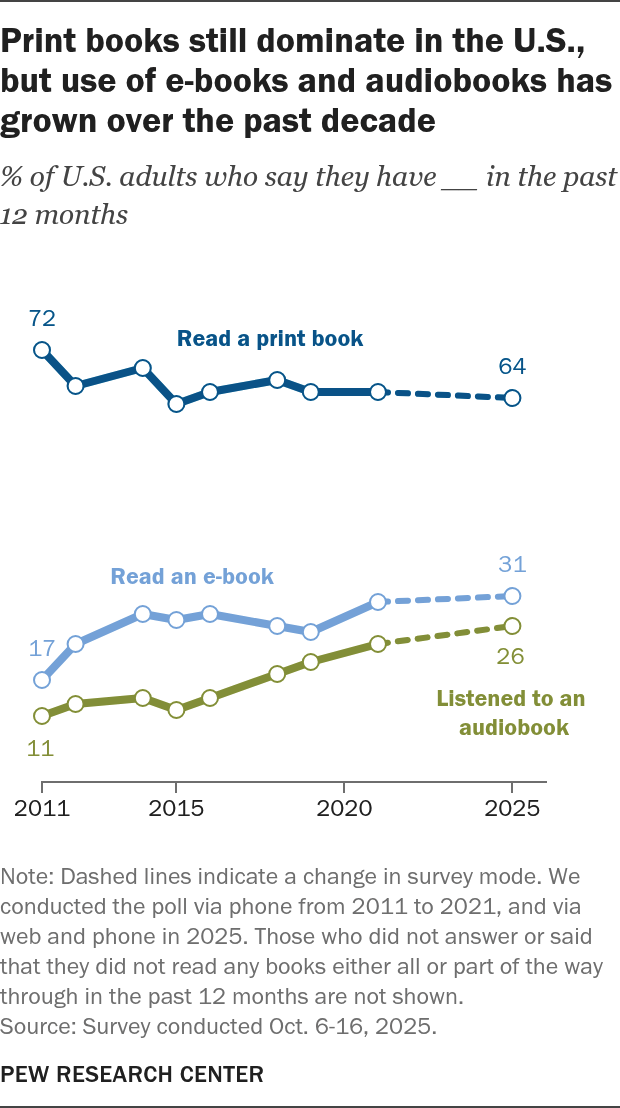
Three-quarters of American adults have read at least part of a book in the past year, according to October 2025 data from Pew Research Center. While print books remain the dominant format at 64%, the data reveals a significant shift: audiobook consumption has more than doubled since 2011, and e-book readership has grown from 17% to 31%. Yet despite digital growth, print's decline has been modest –just eight percentage points over 14 years. For publishers, these figures underscore a multi-format reality where consumer preferences are fragmenting rather than consolidating, demanding sophisticated portfolio strategies across physical and digital channels.
Understanding format preferences is no longer an academic exercise for publishers –it's a strategic imperative. The publishing industry has spent the past decade and a half navigating the digital transition, initially bracing for print's demise following the e-book boom of the early 2010s. That disruption never fully materialised; e-books plateaued, and print proved remarkably resilient.
Now, with audiobooks showing sustained growth and streaming platforms entering the market, publishers face a more complex landscape. Production decisions, rights management, pricing strategies, and marketing investments all hinge on accurate assessments of format demand. The Pew data–spanning 14 years and capturing post-pandemic behaviors –offers rare longitudinal insight into actual consumer behavior rather than industry projections.
Moreover, the demographic variations revealed in this research have direct implications for audience development and content strategy. The fact that college graduates read at rates 28 percentage points higher than those with high school education or less, or that younger audiences disproportionately favor digital formats, should inform everything from acquisition decisions to distribution partnerships. For an industry where margins are tight and overproduction remains a persistent challenge, misreading format preferences can mean the difference between profitability and loss.
Print's resilient market position
The most striking finding in Pew's October 2025 survey is not digital growth but print's enduring strength. Two-thirds of American adults (64%) report reading a physical book in the past year –a decline of only eight percentage points since 2011. This modest erosion contradicts earlier predictions of print's rapid obsolescence following the e-reader revolution.
For publishers, this resilience validates continued investment in physical book production, distribution infrastructure, and retail partnerships. Print remains the only format used by a majority of Americans, and its staying power suggests fundamental consumer preferences that transcend technological convenience. The tactile experience, the lack of screen fatigue, the collectibility, and the giftability of physical books continue to drive purchasing decisions.
However, the demographic breakdown reveals important nuances. White Americans show the highest print readership at 67%, compared with smaller shares among Black, Hispanic, and Asian Americans. This variance likely reflects both cultural preferences and socioeconomic factors, including access to physical bookstores and library systems. Publishers focusing on diverse audiences may need to reconsider their format mix, potentially emphasizing digital accessibility where print distribution faces structural barriers.
The stability observed since 2021 is particularly noteworthy. After years of steady decline, print readership has plateaued, suggesting the format has found its natural floor rather than continuing a death spiral. This stabilization allows for more confident long-term planning around print runs, warehouse capacity, and retail relationships –all areas where uncertainty has plagued publishers throughout the digital transition.
Digital audio's sustained growth trajectory
While print holds steady, audiobooks represent the format success story of the past decade. Consumption has more than doubled from 2011 levels, and the growth shows no signs of abating. This expansion mirrors broader trends in audio content consumption, from podcasts to voice-first interfaces, suggesting publishers are benefiting from platform-level shifts in media behavior.
The demographic profile of audiobook listeners offers strategic insights. Younger Americans adopt the format at significantly higher rates: 41% of adults under 30 report audiobook listening, compared with a third or fewer in older age groups. This generational divide suggests audiobooks will continue gaining market share through cohort replacement alone, as younger consumers carry their format preferences into middle age.
For publishers, audiobook growth presents both opportunity and challenge. Production costs - without the use of AI - remain substantially higher than e-book conversion, requiring careful title selection and ROI analysis. The data suggests certain categories and audience segments justify this investment more readily than others. Non-fiction, which has shown stronger audiobook adoption in markets like the U.S. and UK, may warrant prioritization over fiction genres where e-books have established dominance.
The format's growth also raises questions about discovery and marketing. Unlike print books, which benefit from physical retail browsing and visual merchandising, audiobooks rely heavily on platform algorithms and recommendation engines. Publishers must develop distinct promotional strategies for audio, potentially including sample clips, narrator information, and integration with podcast marketing where audience overlap exists.
E-books: the plateau continues
E-book adoption tells a more ambiguous story. While readership has grown from 17% in 2011 to 31% in 2025, the format has shown little movement since 2021, suggesting it has reached a natural ceiling in the U.S. market. This plateau contradicts earlier projections that positioned e-books as print's inevitable successor.
The demographic breakdown offers clues to this stagnation. Asian Americans show the highest e-book adoption at 42%, significantly above the 30% range for other racial and ethnic groups. This variance may reflect different reading contexts, device ownership patterns, or genre preferences. College graduates also demonstrate higher e-book usage, consistent with the format's strength in professional and academic content where searchability and portability offer distinct advantages.
For publishers, the e-book plateau necessitates realistic revenue projections and format allocation decisions. The days of double-digit e-book growth are behind us, replaced by a mature market where gains come from optimization rather than expansion. This maturity actually offers certain advantages: stable demand allows for more predictable pricing strategies, back-catalog monetization, and platform negotiations.
The gender gap in e-book readership –with women more likely than men to use the format –aligns with broader patterns in book consumption but suggests missed opportunities in male-skewing categories. Publishers in genres like business, technology, and certain non-fiction segments might explore why their natural audiences aren't embracing digital text formats, potentially finding audiobooks offer better format-market fit.
The book club gap and community engagement
Finally the survey also questioned book club participation: just 7% of adults report involvement in the past year. This low figure has implications for publishers' community-building and marketing strategies.
Book clubs have long been valorized in publishing as ideal consumers-engaged readers who buy books, discuss them, and influence others' purchasing decisions. The reality that 93% of Americans don't participate in book clubs suggests this channel's impact may be overstated, at least in its traditional form.
The gender divide is pronounced: 10% of women participate compared with just 5% of men. This gap reflects broader patterns in reading culture but also highlights the challenge of building male reader communities. For publishers seeking to expand their audience, understanding why book clubs remain niche –and exploring alternative community formats –becomes critical.
Digital platforms have attempted to recreate book club dynamics through online communities, social reading apps, and influencer-driven book recommendations. The modest participation rates in traditional book clubs suggest opportunity for innovation, but also caution: if only 7% of readers join structured reading communities, publishers should temper expectations about community-driven discovery and word-of-mouth marketing, focusing instead on individual reader relationships and algorithmic discovery.
Reading volume and market concentration
The distribution of reading volume reveals a highly concentrated market. While 75% of Americans read at least one book annually, consumption clusters at the low end: 38% read just one to five books per year, while only 14% read more than twenty. This concentration has profound implications for publishers' business models.
Heavy readers–those consuming more than twenty books annually–represent a disproportionate share of industry revenue despite being a small fraction of the population. These super-consumers likely drive genre fiction sales, participate in subscription services, and respond to serialized content strategies. Understanding their format preferences and discovery behaviors should be a strategic priority.
Conversely, the 38% reading one to five books annually represent a different challenge and opportunity. These casual readers likely concentrate purchases around major releases, gift-giving occasions, and high-visibility titles. For publishers, converting these occasional readers into more frequent consumers–or capturing a larger share of their limited reading budget–requires different tactics than serving heavy readers.
The 25% who read no books at all represent the market's outer boundary. While converting non-readers falls partly outside publishers' direct control, understanding barriers to reading –time constraints, cost, format preferences, discovery challenges–could inform product development and pricing strategies that lower entry barriers for marginal consumers.
Strategic implications for publishers
The Pew data confirms what many publishers have experienced: we live in a multi-format world where consumer preferences fragment across print, digital text, and audio. The strategic question is no longer which format will win, but how to optimize across all three while managing the cost and complexity of multi-format production.
Print's resilience demands continued investment in physical book quality, design, and retail relationships. However, the modest decline suggests publishers should resist overproduction and focus on titles where print offers distinct advantages–visual content, collectibility, gift potential, and genres where physical browsing drives discovery.
Audiobook growth justifies expanding production, but selectivity remains essential given high costs that could be lowered by the use of AI. Publishers should prioritize categories showing strong audio adoption, invest in narrator quality as a differentiator, and develop platform relationships beyond Amazon's Audible to capture growth from Spotify and emerging competitors.
E-book maturity calls for optimization over expansion: dynamic pricing, back-catalog activation, and format bundling that increases customer lifetime value without cannibalizing print sales. The plateau also suggests experimenting with enhanced e-books that leverage digital capabilities beyond simple text replication.
Demographically targeted strategies become increasingly important. Younger audiences' digital preferences suggest different marketing and format emphasis than older readers. Educational attainment correlates strongly with reading volume, indicating opportunities in professional and lifelong learning categories. Racial and ethnic variations in format preference should inform both content development and distribution strategies.
The low book club participation rate suggests publishers should diversify community engagement strategies, exploring influencer partnerships, digital-first communities, and parasocial relationships that better match contemporary media consumption patterns.
Source: Pew Research Center