The blind spot in AI detection
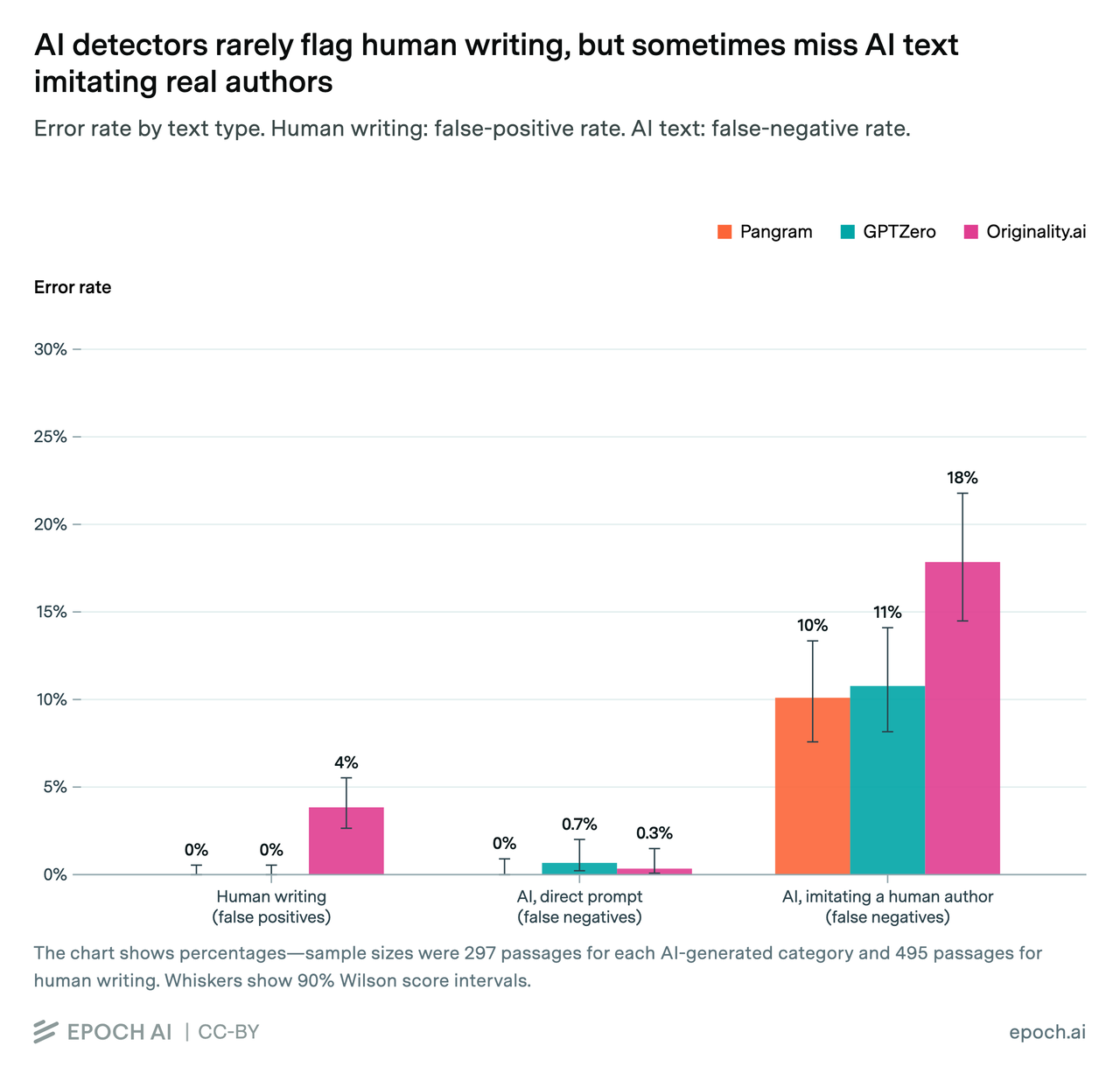
AI detectors rarely flag human writing, but they sometimes miss AI-generated text that closely resembles the writing of real authors
As generative AI models become increasingly sophisticated, publishers across trade, academic, and journalistic sectors have turned to automated AI detectors as a primary filter against uncredited machine-generated manuscripts. However, an evaluation by research organization Epoch AI (July 2026, by Jaeho Lee) reveals a fundamental vulnerability in these tools: while detectors sometimes excel at flagging generic AI output, they routinely fail when models are instructed to mimic a specific author’s style.
Published: 28.7.2026 | Foto / Video: AI generated, Magnific
For publishing executives, managing editors, and peer-review coordinators, the study highlights critical limitations in current verification workflows—particularly within scientific and academic publishing.
Key findings at a glance
Direct AI prompts are easily caught: When models generate text from basic instructions (e.g., "Write a short story about a lost dog"), detection rates are near perfect—false negatives averaged under 1% across all tested platforms.
Style imitation creates a ~13% blind spot: When frontier models (Claude Opus 4.8, GPT-5.5, Gemini 3.1 Pro) were supplied with just five sample passages of an author's work, detectors failed to flag the resulting AI text in roughly 1 in 8 cases (10% to 18% evasion rates).
Scientific publishing faces the highest risk: Style-imitated scientific writing bypassed detection in 24% to 29% of cases across all three major platforms, peaking at a 48% failure rate in specific model-detector pairings.
False positives remain low (with one notable exception): Pangram and GPTZero flagged 0% of genuine human writing as AI, whereas Originality.ai misidentified 3.8% of human passages—reaching 10% in human-written fiction.
The faulty scales of digital authorship
Why some AI detectors cannot be trusted | Authors Guild put five of them to the test

How the study tested top detection tools
The Epoch AI evaluation benchmarked three widely deployed detection platforms using state-of-the-art engine versions:
Pangram (v3.3.2): A neural classifier trained with extensive "hard-negative mining" designed to push false positives toward zero.
GPTZero (model 2026-05-11-base): A detector relying on "perplexity" (predictability of word choices) and "burstiness" (variation in sentence structure and predictability).
Originality.ai (Turbo 3.0.2): A supervised classifier trained on large datasets of labeled human and machine-written text.
The baseline human dataset comprised 495 passages (~500 words each) from 99 authors across three genres: blogging, fiction, and scientific writing (scientific writing sourced from pre-2022 arXiv papers; blogging and fiction from pre-2022 Wayback Machine snapshots, all predating ChatGPT to rule out AI contamination). This was benchmarked against 297 AI-generated passages per condition (594 in total) under two distinct prompting conditions: generic topic prompts and five-shot style imitation.
Performance breakdown across genres and tools
When breaking down false negatives by genre, a sharp divergence emerges. While trade fiction and general blogging remain relatively easy for detectors to spot, technical prose causes detector accuracy to degrade significantly.
Fiction: 1% (Pangram) | 2% (GPTZero) | 5% (Originality.ai)
Blogging: 4% (Pangram) | 6% (GPTZero) | 19% (Originality.ai)
Scientific writing: 25% (Pangram) | 24% (GPTZero) | 29% (Originality.ai)
The reason for this failure lies in the nature of academic writing. Scholarly articles heavily utilize standardized passive voice, field-specific terminology, and highly structured, predictable phrasing. When an AI model is instructed to mimic a researcher's past papers, its structural output closely aligns with accepted academic prose, neutralizing the statistical randomness ("burstiness") that detection algorithms rely on.
Tactical implications for publishing leadership
1. Re-evaluate automated screening in slush piles and peer review
The zero-false-positive scores for Pangram and GPTZero indicate that a positive AI flag on standard prose is highly reliable. However, a negative result is not proof of human origin. Editorial teams using automated tools to filter submissions must treat a clean report as a baseline check, not a guarantee of original authorship.
2. Prepare for targeted author profile prompting
As AI context windows expand, bad-faith contributors or ghostwriters can easily feed an author's backlist or previously published papers into a model prompt before generating a manuscript. Epoch AI's data shows this simple technique bypasses automated filters in roughly a quarter to nearly a third of cases (24% to 29% depending on the detector) in scholarly publishing.
3. Mitigate false-positive risks in creative imprints
Originality.ai's 10% false-positive rate on genuine pre-2022 human fiction highlights the legal and ethical hazards of automated "reject-on-detection" policies. Wrongfully accusing authors of unauthorized AI usage risks damaging author relationships, generating public backlash, and triggering contractual disputes.
Practical steps for implementation
1. Adopt a hybrid verification model: Combine automated software with human editorial oversight, contextual consistency checks, and author provenance verification (such as revision histories, working outlines, or raw research notes).
2. Establish clear author disclosure standards: Implement policies that define permitted uses of AI tools (e.g., proofreading, coding assist, copyediting) versus prohibited uses (e.g., uncredited text generation), encouraging transparency over covert bypass tactics.
3. Customize evaluation protocols by department: Academic, medical, and STM journal departments should enforce stricter submission verification standards than fiction or trade imprints to account for the ~25%+ detector failure rate on technical prose.