Fewer readers, fewer copies
Federation of European Publishers: The record run of Europe's publishers is over
At Frankfurt Book Fair, the Federation of European Publishers reported that net publishers' turnover fell to 24.6 billion euros in 2025, ending a stretch of small nominal growth. A year after the record, the picture is thinner on almost every measure. Volumes, real revenue and profitability are all under pressure, and the sector's deeper worry is a shrinking readership.


Published: 8.10.2026 | Fotos: FEP
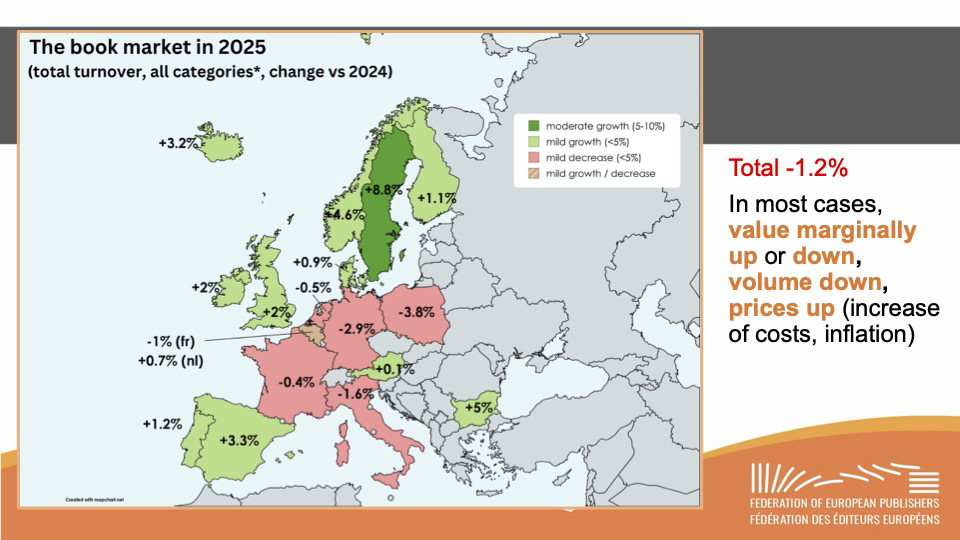
A year ago the FEP reported a record of nearly 25 billion euros, up 2.2 percent. This year, at the 2026 edition of its "data traveling show" on 7 October, Deputy Director Enrico Turrin delivered the correction. "Unfortunately, news is not very good," he said. Turnover fell about 1.2 percent. After "three years of small growth due to prices rather than increases in volume", he said, the market had finally become "intellectually honest".
Adjusted for inflation, the number is starker. Real turnover is 15.2 billion euros, down from 15.5 billion a year earlier. Over twenty years, Turrin said, "if nominal turnover is up about ten percent, real turnover is down about thirty percent. So maybe we have a problem." He added a reassurance: "We're still alive and kicking, but there is something going on underneath."
FEP President Sonia Draga set the tone in her opening remarks. She said the sector needs "more and more evidence of the impact that various challenges are having on our sector", and named "the ever present AI, the rise of secondhand book sales, the current geopolitical tensions". The data, she said, should help the FEP propose support policies to the European institutions.
Fewer copies, fewer titles, less money per title
In a sample covering 75 percent of turnover, print sales fell about 6 percent after 2020, which is around 110 million copies. Last year's report put the loss at 95 million, or 5 percent. In total, Europeans still bought about 2.4 billion copies. "Not all of this has changed into digital," Turrin said. "Some is because, unfortunately, we have lost a few readers along the way."
New titles fell to 570,000 from 580,000, after peaking above 600,000 about ten years ago. Turrin called that "still a hell of a lot of books", but warned that self-publishing and AI have produced "an amount of stuff around, I hesitate to call them necessarily books, that is mind blowing".
Prices do not close the gap. Over 25 years, Turrin said, "book prices have increased forty three point eight percent on average in Europe, according to Eurostat. The general level of prices increased seventy five percent." In 2025, books rose 1.9 percent against inflation of 2.5 percent. Revenue has stagnated while title counts rose, so, in his words, "simple math, less money per title". He also called the shift to digital, audio and subscriptions "a different and maybe not as profitable business model".
This content is blocked by your cookie settings. 🍪
You can change this in the cookie settings or accept and load it for this visit only.
Formats, channels, categories
Formats. Print fell to 81.6 percent of publisher turnover (82.9 percent a year earlier). Digital is at 13.1 percent. Audio reached 5.3 percent, up from 4.2 percent, and Turrin said that is "an underestimate" because digital sales are harder to track.
Bookstores. The post-Covid recovery has stalled. Bookstores account for 48.1 percent of turnover, after 50.3 percent in 2019. "It looks like the return to physical bookstores that came after COVID has kind of dwindled." Online holds at 23.6 percent, but the figure counts only what publishers sell directly. "The actual share of books that are sold online is much higher than that."
Children's books. Their share reached 15.2 percent, the highest in the series since 2008. A year ago the FEP stressed demographic headwinds. Turrin still named those headwinds, "a bit because there are fewer and fewer children in Europe, a bit because unfortunately, it seems that children are reading less", but sales picked up again in several markets.
Academic and professional books. Their share fell to 14.8 percent, from 21.5 percent in 2008. Turrin blamed fewer printed textbooks at universities, a trend "exacerbated now by AI". He stressed the figures cover books, not journals. "But scientific publishers are doing fine. No worries. Don't go and sell your shares because I showed you this."
Exports. They stay at about a fifth of turnover (20.6 percent). "For the Brits, it's almost half of the turnover. For others like Italians, it's barely visible."
Reading under the microscope
The Eurostat figure of 47.2 percent non-readers is unchanged from last year, because it comes from a 2022 survey. Turrin called it "for me awful", but added a caveat. "Methodology changes, data are not really comparable." The survey also covers only people aged 16 and over, so it misses younger children, who are often still strong readers. On Italy's low reading rate he joked, "I'm Italian. We're not so good, but not so bad either."
The breakdowns are stark. Among men, 55.5 percent read no books, against 39.5 percent of women ("Shame on us," Turrin said). With low education, the share is 67.6 percent, against 22.9 percent for university graduates. "Does education make you read more, or does reading more make you get a better education? Probably it worked both ways." Rural readers lag city readers, and people at risk of poverty read less. Yet only 1.8 percent of non-readers cite cost, and 51.3 percent cite no interest. Turrin's conclusion was, "We don't have to make books cheaper. We have to make them sexier."
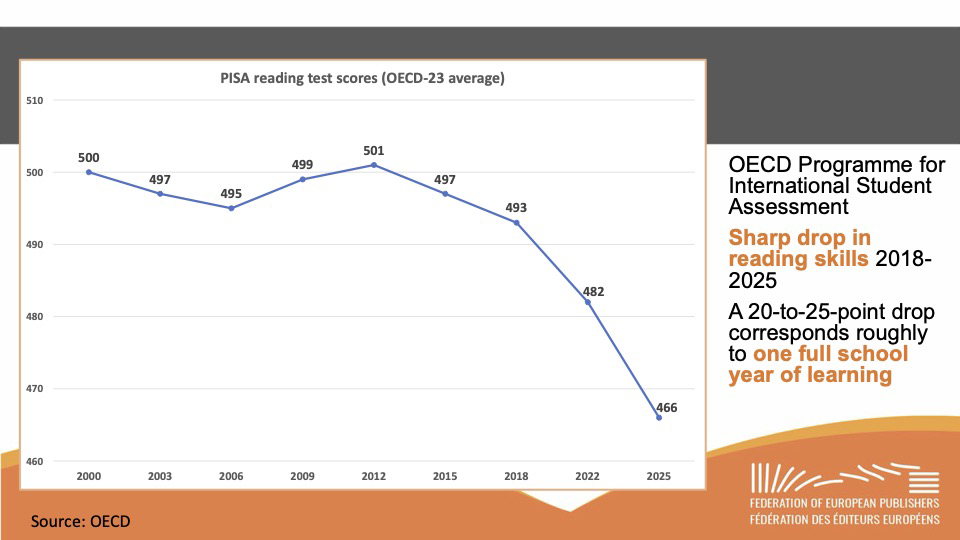
On reading skills, the OECD-23 average in PISA fell from 493 points in 2018 to 466 in 2025. Turrin said that is "the equivalent of one year of schooling" lost.
Markets
Using a weather metaphor, Turrin described "stormy weather on Central Europe". Germany fell 2.9 percent, Poland 3.8, Italy 1.6 and France 0.4. The Nordics, the British Isles and Iberia fared better, with Sweden up 8.8 percent. Sweden's print recovery was the clearest policy effect. "The Swedish government figured out that they might have overdone the digitization in education." It funded print books in schools, "not only textbooks, but also fiction. And what do you know? It shows."
Compared with 2019, "two powerhouses like France and Germany are barely above the level of sales of two thousand nineteen. If you account for inflation, we are below." Physical bookstore sales in Germany and Italy have not returned to 2019 levels.
The first half of 2026 shows the same split, with Poland down 11.7 percent, Germany down 4.1 and France down 5 (through August). Italy is up 5.1 percent, though Turrin said the latest figures are closer to plus 3 percent. His outlook was cautious: "But probably the final result for the year will be not too different from last year."
Spain's "fenómeno español" now spans twelve years of growth, with domestic turnover of about 3.14 billion euros in 2025. Turrin's caveat was that this puts Spain "pretty much at the level of two thousand and eight".
Markets
In 2024 the EU imported about 1.84 billion euros of books and exported 1.75 billion. The UK is the biggest partner. "You can bet those six hundred million that we import are books in English that we read." Chinese imports, worth 567 million euros, are printing orders. "Do we all read Chinese? No. We print those books in China."