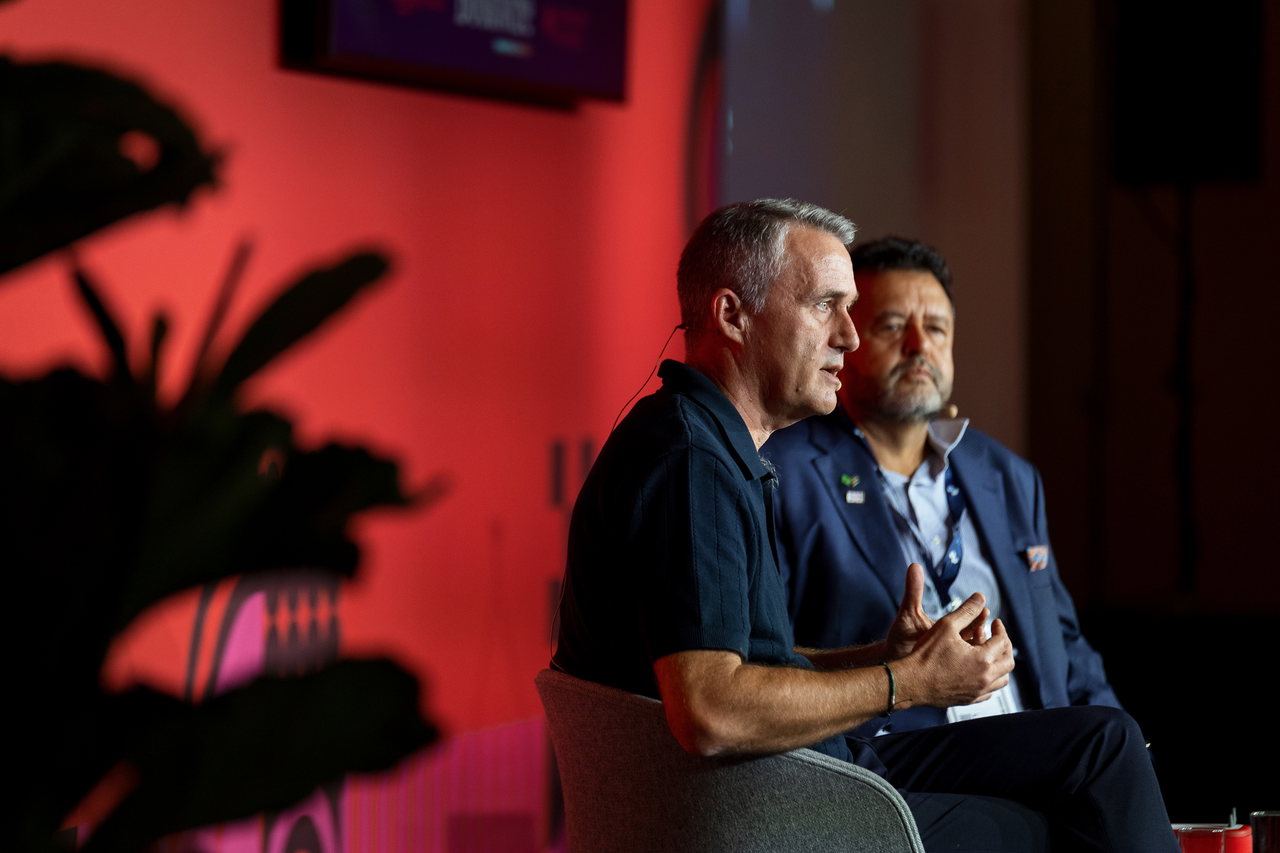
Global 50 CEO Talk: Wischenbart, Carrenho and tonies CEO Tobias Wann at the Book Fair
800 million euros with the audio box: tonies CEO Wann at the Book Fair
For the 20th time, Rüdiger Wischenbart has published the Global 50 Publishing Ranking. At the Frankfurt Book Fair he presented the new analysis which is sponsored by Bookwire and co-sponsored by Rakuten Kobo together with Carlo Carrenho, who then spoke with tonies CEO Tobias Wann about growth, publisher partnerships and artificial intelligence.
Published: 7.10.2026 | Fotos: Johanna Baschke
Bookwire CEO Jens Klingelhöfer opened the talk with a look back. Wischenbart published the first edition in 2007, the year of the first iPhone. Bookwire and tonies did not exist yet. This year's edition, he said, describes the shift from a controlled value chain to an open network ecosystem, in which stories travel as print, streams, subscriptions or serials on a phone, and everyone competes for the same resource: attention.
The 48 ranked companies of the new report (download here) together generate around 65 billion euros in revenue, or roughly 73 to 74 billion US dollars. By Wischenbart's estimate, that equals about half of the global book publishing business in the traditional sense. You never get complete data in a survey like this, he said, but the coverage is representative.
Asked by Carrenho about long-term patterns, Wischenbart first named the industry's astonishing stability. Surprises are rare, the market structure stays largely the same, and the biggest players keep growing. Newcomers that suddenly rise to become world leaders hardly exist. He called the industry still conservative. Growth, he said, is happening mainly outside traditional publishing.
Concentration at the top is pronounced: the ten largest publishers account for half of the revenue of all 48 ranked companies. By Wischenbart's calculation, that is about a quarter of the entire industry.

Bertelsmann on top: education reshapes the ranking
The most striking change concerns the top spot. For years, Pearson and scientific and professional publishers such as Wiley, Elsevier and Thomson Reuters led the list. For Thomson Reuters, the ranking counts only the publishing business, not the news agency. This year, Bertelsmann is at the very top for the first time.
The reason is less Penguin Random House than education. Bertelsmann began building an education arm with great energy a few years ago, and it has now grown to revenue of almost one billion euros.
According to Wischenbart, the biggest loser in the education segment is Pearson, which remains strongly focused on textbooks and lost revenue. Other education publishers, by contrast, have radically redefined themselves as learning companies, with their own schools, employed teachers and digital learning platforms. In his words, this shift began in Korea, not in the US or Europe. It makes the question of what a publisher actually is increasingly hard to answer, and it is now reaching trade and consumer publishing as well.
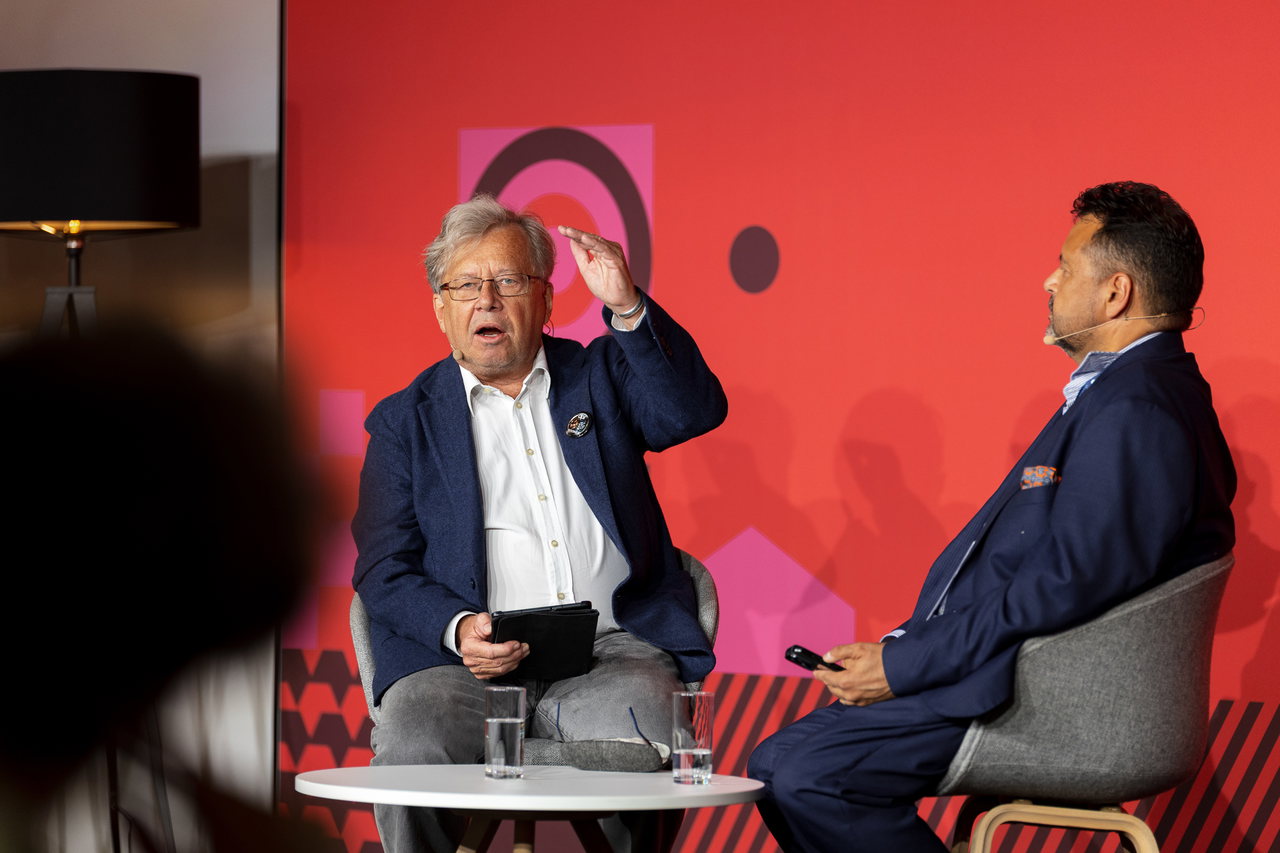
The book beyond publishers
The current edition puts more focus on the Global South and on players outside classic publishing. For a long time he had a blind spot here, Wischenbart admitted: Brazil was represented by a few companies, and an Indian company was missing entirely. For Latin America, Talita Facchini of Publish News Brazil contributed a portrait of the companies. For India, Taylor & Francis India provided an overview of a market that is fragmented across many languages and at the same time strongly platform-driven.
The study has pursued the concept of "publishing beyond publishers" for three years. Wischenbart pointed to self-publishing, which has become massive but for which hardly any data exist. Neither the number of readers nor revenues are known. By his estimate, the largest players are in the same league as the largest consumer publishers. The same applies to audio platforms, which are growing more dynamically than ever.
As the latest example he named microdramas in China, video series that tell their story in one minute. They reach large audiences and could partly offset declines in the traditional sector.
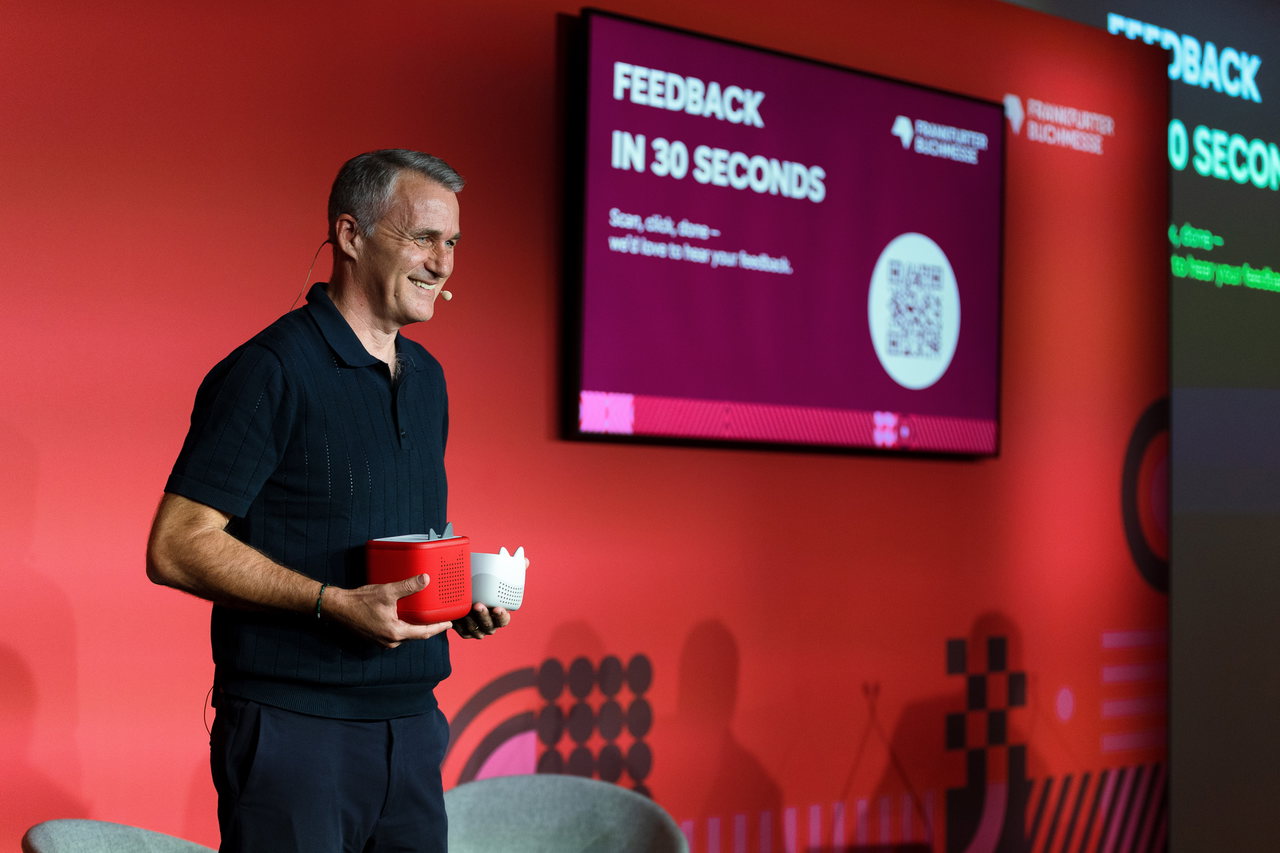
tonies: 800 million euros from an audio box
Carrenho, who lives in Sweden, where audiobooks hold more than 60 percent market share by units sold, spoke with Tobias Wann, CEO of tonies for about three years. Wann does not come from the book industry and does not see tonies as clearly belonging to any one industry. He was brought in to scale the company globally.
tonies is almost exactly ten years old. The idea was born in the living room of two fathers in Düsseldorf, and the product launched in Germany in the fourth quarter of 2016. Today the company operates in ten markets and expects revenue of around 800 million euros this year. According to Wann, tonies has sold about 12 million Toniebox devices and more than 170 million figurines in total. The box is played in over 100 countries, he said, including places where tonies does not officially sell.
The principle is deliberately simple: put the figurine on the box and the content starts. Children from age one operate the box themselves, it sits in the child's room and can be carried anywhere, unlike a smartphone or TV. Worldwide, children listen for about five hours a week on average. Internally, tonies calls the device the "yes box," because parents can happily say yes when a child asks for one more story.
The offering now forms an ecosystem of several products:
the classic figurines for children aged roughly three to six, with original and licensed content
"My First Tonies" for children from age one, on the market for a year
Book Tonies and Clever Tonies with audiobooks and educational content for older children
Tonie Play, audio games for the Toniebox 2, which replaced the first generation last year, including its own version of Hasbro's Game of Life
Creative Tonies, onto which users can load their own content
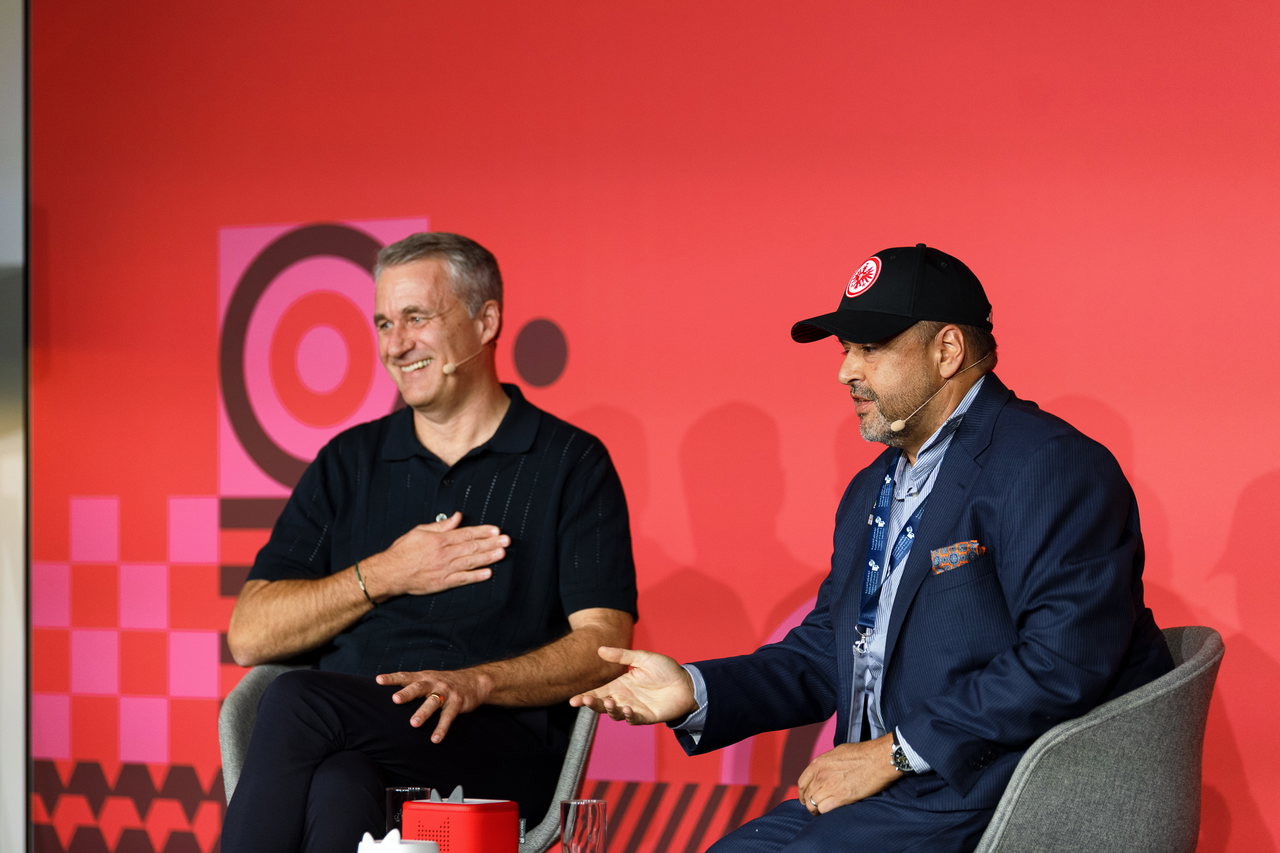
Publishers, licenses and in-house content
From the media partners came the question of what role publishers will play in the future if tonies increasingly produces its own content. Wann answered that publishers have always played a role and will keep it. The majority of content on the platform is and remains licensed.
In-house formats emerge where tonies can read from usage data when children listen. One example is "Sleepy Friends," one of its most successful original brands. It was created because the box is used especially often at bedtime, and a calming story fits that moment better than a superhero audio play.
According to Wann, there are several ways for publishers to work with tonies:
finished audio productions that can be taken over directly
film audio from partners such as Disney and Paramount, which cannot simply be transferred to the box and is therefore retold as an audio experience in the company's own studio, so that the character is available at the cinema release
ideas and stories without audio, which are developed together in the studio
Big or small makes no difference, he said. Even an original brand does not need a big name behind it if it meets the needs of a family household. What matters is that content is built for the box, with its limited length and the figurine as the way in. Major rights holders now talk to tonies two to three years before a new film launches, Wann said, and he himself receives many ideas by email.
Wann illustrated how children get to know brands through the box with an anecdote. A senior executive at a large media company watched a new film from his own house with his granddaughter. She said she already knew the story, from her Toniebox. First contact with a character, Wann concluded, no longer necessarily happens through cinema or screens.
AI: yes in operations, no in the box
Asked about AI narration, Wann gave a nuanced answer. tonies tested early what generative AI can do. Two to three years ago, around 3,000 households tried an "AI Storyteller." In the app, parents entered the child's name and age, perhaps the name of a friend, and a topic. A safeguarded AI generated a story from that, which could be loaded onto an empty Creative Tonie. Wann called the observations fascinating. A repeat with a personalized Christmas wish list, read aloud by Santa Claus, worked as well.
Still, he draws a clear line for the product. The Toniebox will never become an AI toy, he said. Parents are rightly skeptical about AI toys, and tonies does not want to be a pioneer here. Applications for older children in education are conceivable later, but only with great caution.
Operations look different. According to Wann, about 85 percent of the workforce uses AI every day, which supports the company's rapid global growth. He encouraged the audience to do the same.
Listening and reading: not opposites
Against the backdrop of the reading crisis that Enrico Turrin of the Federation of European Publishers had described on the same stage earlier that day, Wann was asked how children who first encounter stories through the box become book readers.
Wann pointed to a study by the University of Wisconsin-Madison, initiated by tonies. It observed children who regularly use the Toniebox and tracked their reading skills. The finding is not listening versus reading, but listening and reading. Anyone who listens five hours a week knows the beginning, middle and end of a story, suspense and characters, and is more open to seeking stories in any medium. The effect shows up until about age ten. For teenagers, tonies has no content.
Asked how to keep children from switching to streaming services such as Audible or Spotify, Wann pointed to the product lines for every age. What a one-year-old listens to no longer goes on the box at six or seven. Serialized content, he added, is also particularly interesting for older children.
Expansion, local content and series
Talita Facchini, speaking for the ranking's media partners, asked whether Latin America or the Nordic countries will be the next markets. Wann explained that after entering the US, the UK, France and most recently Australia from around 2021, tonies deliberately paused because these markets grew faster than expected. They remain the priority. From 2027, however, tonies will continue its internationalization, with at least two new countries next year, which he did not want to name yet. By 2030 the company aims to be present in all major regions, including Asia and Latin America. The latter is large and, with two dominant languages, easy to develop from country to country.
Wann called local content part of the DNA. In France, the only country with an existing competitive environment, tonies became market leader in a short time and the fastest-growing preschool toy maker, in his words, also because French content was the focus from the start. Even in Australia, tonies produces content that exists only there.
The session ended with football. Carrenho asked why there is a tonie for FC Bayern but none for Eintracht Frankfurt. Wann revealed that talks began with Frankfurt, but implementation there was more difficult for understandable reasons. FC Bayern stepped in. The Bayern tonie is an example of serialized content: it downloads a new episode for every home game, so roughly every two weeks. Another example is the Advent calendar, which is in high demand in Germany and plays a different story on each of 24 days.