Red alert in the children’s room
German book market 2025 sees turnover drop as youngest buyer demographics decline sharply
The German book market recorded a noticeable decline in turnover for 2025. While audiobooks are booming and ‘New Adult’ novels continue to flourish, a severe downward trend is weighing heavily on the industry: younger consumer groups are turning their backs on books to an alarming extent.
Published: 9.7.2026 | Foto / Video: Magnific
The figures presented today by the German Publishers and Booksellers Association (Börsenverein des Deutschen Buchhandels) in its study ‘Buchmarkt kompakt 2025/2026’ shed a critical light on the trajectory of reading culture. The book industry closed the financial year 2025 with a total turnover of €9.619 billion. While this may sound substantial, it represents a 2.7% decline compared to the strong previous year (€9.882 billion). Alongside the sluggish economy and general consumer uncertainty, a far more structural problem is emerging: young people are abandoning books. Overall, the number of book buyers fell by 4.9% in 2025. In fact, since 2013, the book market has lost around 10 million buyers—a collapse of nearly 30%.
Sharp decline among the youngest: around one-third fewer buyers
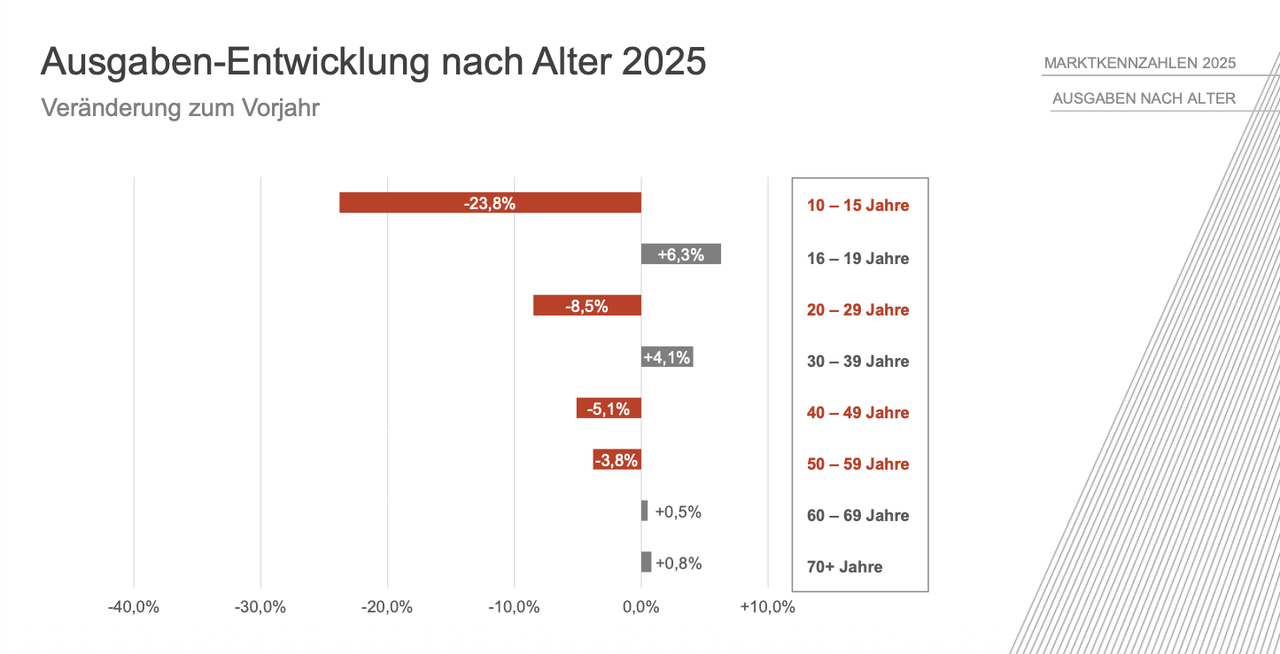
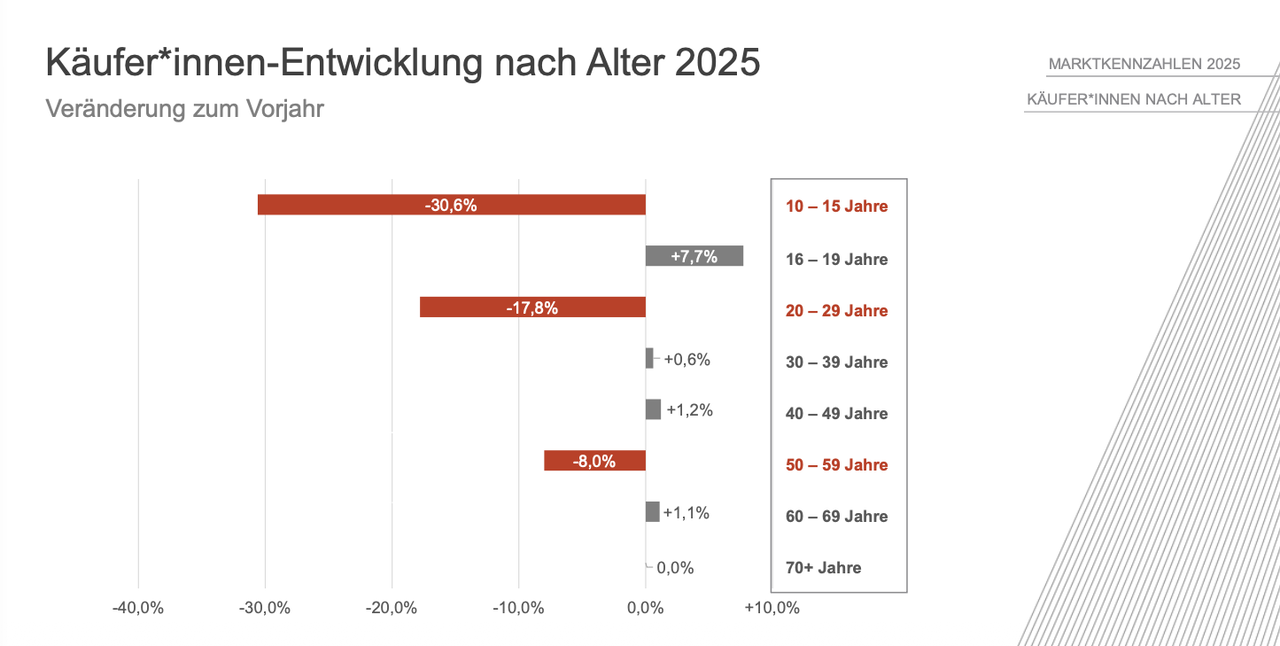
The industry is hit particularly hard when looking at the youngest generation. Among 10- to 15-year-olds, the number of book buyers plummeted by 30.6%. This decline is directly reflected in revenue, with expenditure in this age group dropping by 23.8%.
The 20–29 demographic also suffered a massive slump, recording a 17.8% drop in buyer numbers and an 8.5% fall in spending. Only teenagers aged between 16 and 19 are currently bucking the trend: in this bracket, the number of buyers rose by 7.7% and spending climbed by 6.3%.
The association is issuing a stark warning about the long-term consequences of this development. If the youngest generation loses the habit of reading—or never picks it up in the first place—the market will lose its very foundation for decades to come.
Silver linings: the audio boom and the ‘New Adult’ hype
The market owes the mitigation of even sharper losses to two major trends: an unstoppable audio boom and emotionally driven niche literature.
The audiobook boom: With a 13.2% increase in turnover, the audiobook segment is the clear winner of the year. This growth is driven entirely by digital formats: while traditional CDs are facing a dramatic decline (-18.6%), streaming subscriptions surged by 23.1% and downloads grew by 9.2%. Streaming (47.2% market share) and downloads (47.4%) now split the audio market almost equally.
Trending genres rescue fiction: The fiction category remained stable with a slight increase of 1.2%, accounting for the largest share of the overall market at 38.1%. This success was largely driven by the hype surrounding New Adult (+9.6% in sales) and Young Adult (+4.8% in sales) genres. The number of buyers in this segment climbed by 8.8% compared to the previous year—though this was not enough to offset the overall loss of buyers.
Distribution channels: brick-and-mortar loses ground, online stabilises
Traditional high-street bookshops remain the most vital distribution channel with a market share of 40.8% (€3.93 billion), but they took a hit, losing 3.7% in turnover. Online book retail (including the e-commerce operations of brick-and-mortar stores) remained virtually unchanged at €2.51 billion (-0.1%), securing a market share of 26.1%.
Department stores, already under immense pressure, were hit far harder, with their book sales plummeting by 25.2%. Meanwhile, the e-book business continues to tread water: its share of the consumer market rose only marginally from 6.1% to 6.3%.
Publishers on the defensive: risk aversion and fewer licences
The volatile economic climate is forcing publishers to exercise extreme caution. Title production fell drastically by 9.8% to just 52,644 first editions (down from 58,346 in 2024). As publishers shy away from taking new risks, the industry is increasingly shifting toward a "retro market": so-called backlist titles (books older than 12 months) accounted for a substantial 57% of all sales in 2025.
International business has also cooled noticeably: the number of translations into German fell by 3.3% to 8,465 titles. However, their share of all first editions rose to 16.1%. Licence sales abroad dropped by 8.0% (6,137 licences sold), with the primary buyers of German book rights being China, Russia, and Spain.
Gloomy outlook for 2026
There is no end in sight to this dry spell. A look at the half-year figures for the first half of 2026 shows that the decline is accelerating. In the first six months of the current year, turnover fell by 4.1% compared to the same period last year, while sales volume (the actual number of books sold) slumped by 4.5%. Minor price adjustments (+0.4%) did nothing to offset this downward trend.