Bertelsmann tops a publishing world that no longer moves in one direction
The Global 50 Publishing Ranking 2026 shows a new leader, a sharp divide between segments, and a book business that increasingly takes place outside traditional publishing houses.
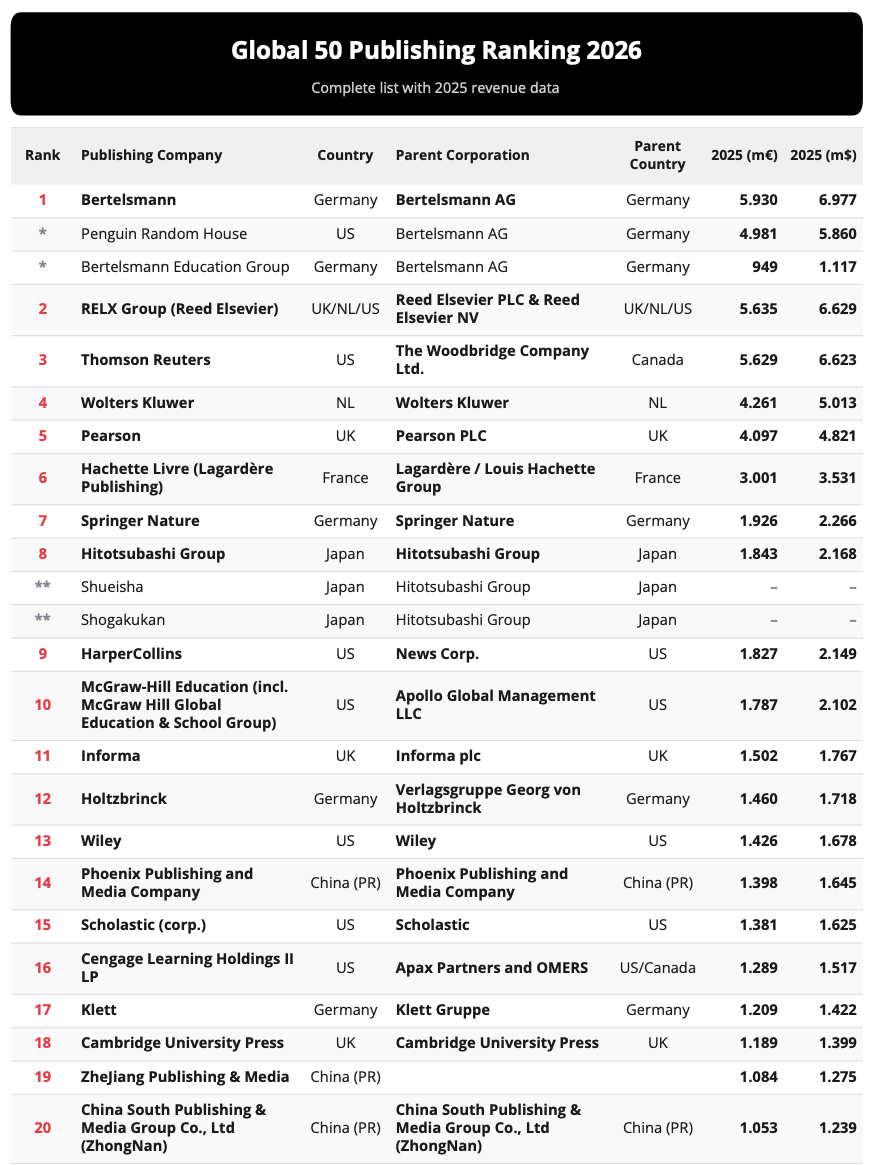
Twenty editions after its launch in 2007, the Global 50 Publishing Ranking has a new name at the top. Bertelsmann leads the list of the world's largest publishing groups with €5.93 billion in publishing revenue in 2025. The figure combines Penguin Random House and Bertelsmann Education Group. Bertelsmann narrowly edges out RELX Group (€5.64 billion) and Thomson Reuters (€5.63 billion), followed by Wolters Kluwer (€4.26 billion) and Pearson (€4.10 billion). Penguin Random House alone generated €4.98 billion and remains the world's largest trade publisher by a wide margin.
Published: 29.9.2026 | Foto / Video: AI generated, Magnific
The report, researched by Rüdiger Wischenbart with international contributors, sponsored by Bookwire and Rakuten Kobo and with Publishing Perspectives, Bookdao and DIGITAL PUBLISHING REPORT as publishing partners, lists 48 publishing groups. Together they earned €64.2 billion in publishing revenue. The top ten account for almost €36 billion of that, or about 56 percent. "The global publishing industry remains remarkably concentrated at the top," Wischenbart says. Consolidation, he adds, continues to be one of the defining forces in the business.
The full report is available free of charge from September 30, 12:00 CEST, at digital-publishing-report.de.
Three segments, three trajectories
The most striking finding is not who leads, but how differently the major segments are developing. For years, the industry could be described with one common trend line. That is no longer the case.
Scientific, technical, medical and professional publishers have become the economic backbone of the industry. Their growth rests on digital services, recurring subscription revenue and highly specialised content. RELX, Thomson Reuters and Wolters Kluwer have long since become information and workflow companies rather than book publishers in the traditional sense.
Trade publishing, often declared to be in crisis, has proved resilient. Several of the largest consumer book groups continued to grow in 2025.
Education, by contrast, is splitting in two. Companies that have moved beyond the printed textbook toward digital learning platforms and services are expanding. Those still tied to conventional textbook models are under growing pressure. "There is no longer one common trajectory for the publishing industry," Wischenbart concludes.
Beyond the value chain
For its 20th edition, the Global 50 deliberately widens its lens. A substantial part of the report looks at players that do not fit the classic definition of a publisher. These include self-publishing services, subscription platforms, serialized storytelling, crowdfunding, content bundles and technology providers. The companies examined range from Spotify, tonies, Yoto and ElevenLabs to Tencent, Empik and the Brazilian subscription service Skeelo.
"Publishing can no longer be understood simply as a chain running from author to publisher to bookseller to reader," Wischenbart argues. The report describes a shift from a controlled value chain to an open, networked ecosystem. In that ecosystem, attention, discoverability, trust and direct access to audiences become the scarce resources, and much of the value is created outside the companies that a revenue ranking can capture.
China and India in focus
Two chapters turn to markets that rarely feature prominently in international comparisons. Sanguo Cheng of Bookdao describes a Chinese book market being reshaped by content-led ecommerce. Sales through platforms such as Douyin, WeChat Channels, Kuaishou and Xiaohongshu grew by more than 30 percent in 2025. By list-price value, this has become the country's largest book-retail channel. Cheng also looks at the rapid rise of Chinese micro-dramas and what they mean for publishers' rights and IP strategies.
Amber Atal of Taylor & Francis India maps the country's leading traditional publishers. She describes a large domestic industry shaped by education and by long-established, often family-controlled companies that are barely visible internationally.
Every book in audio, every reader worth keeping
Two interviews complete the report. Jens Klingelhöfer, CEO and co-founder of Bookwire, discusses audiobook growth, AI-driven production and new distribution channels. He states his ambition plainly: "Personally, I would love to see every book available in audio one day."
Michael Tamblyn, president and CEO of Rakuten Kobo, talks about changing reading habits, subscriptions and Kobo's renewed push into the U.S. market. His main concern is the occasional reader, whom the industry must work harder to reach and keep. "We should never give up on that reader," Tamblyn says. Whether books remain a mass medium, he suggests, depends on it.
Presentation in Frankfurt
The Global 50 Publishing Ranking 2026 is co-published by Publishing Perspectives, Bookdao and DIGITAL PUBLISHING REPORT, with support from Bookwire and Rakuten Kobo and 13 international media partners. Wischenbart will present the findings at the Global 50 CEO Talk on October 7 at 12:00 on the Dialogue Stage of the Frankfurt Book Fair. Afterwards, tonies CEO Tobias Wann will be interviewed live.
The full report is available free of charge from September 30, 12:00 CEST, at digital-publishing-report.de.
The report is supported by 13 international media partners: Books+Publishing (Australia), PublishNews (Brazil), Livres Hebdo (France), All About Book Publishing (India), Giornale della Libreria (Italy), Hon.jp (Japan), inct (Netherlands), BOK365 (Norway), Rynek Książki (Poland), PublishNews (Spain), Boktugg (Sweden), The Bookseller (U.K.) and Publishers Weekly (U.S.).