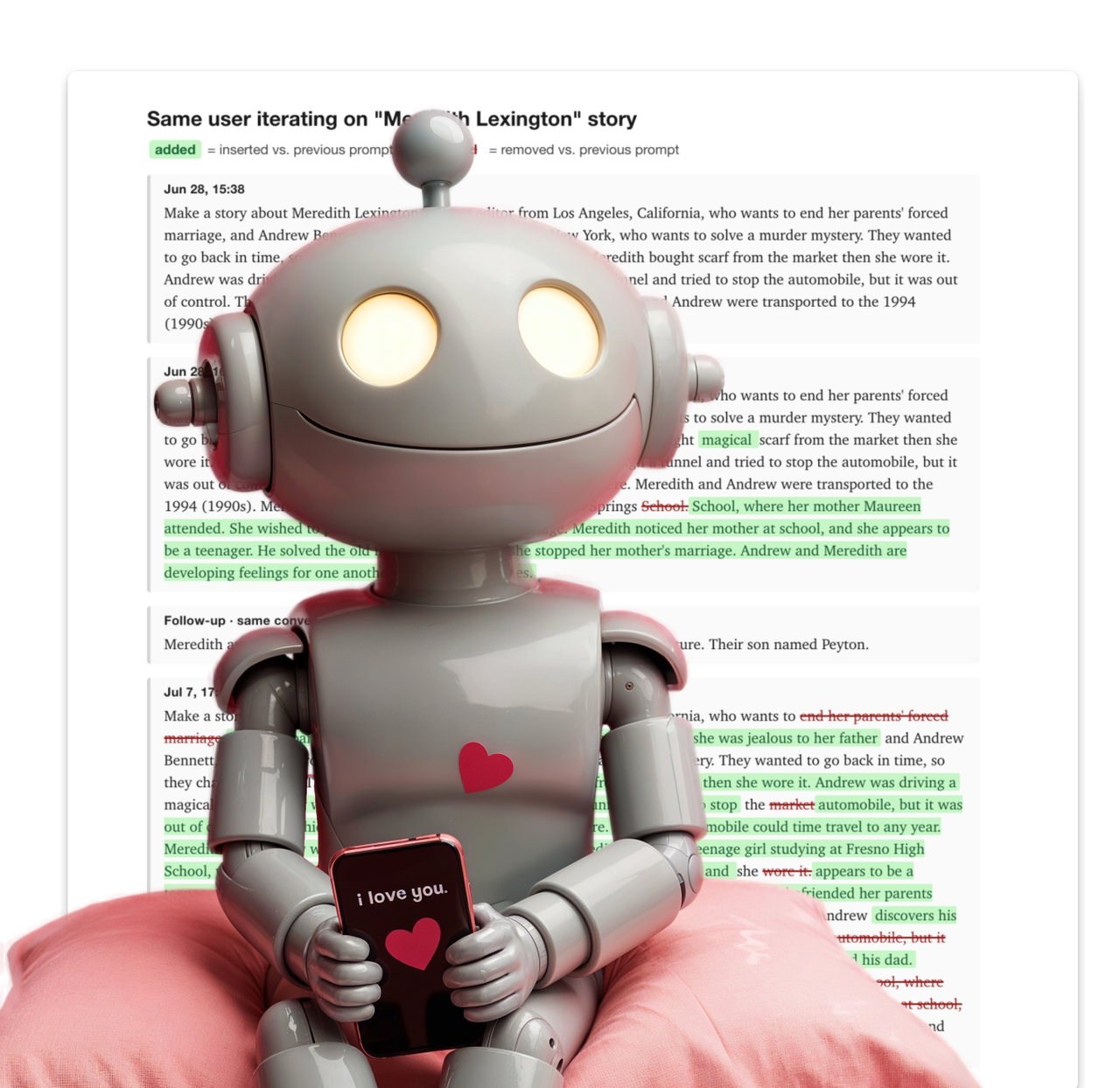
When readers are becoming fiction generators
How ChatGPT users are reshaping literary consumption through repetition and personalization
An analysis of over 500,000 anonymized ChatGPT conversations shows that more than one-third involve fiction generation—predominantly fanfiction and erotica—revealing emerging patterns of solipsistic reader-writers who consume and create stories in closed loops, potentially transforming the fundamental social contract between authors and readers.
Published: 25.6.2026 | Foto / Video: Screenshot study, AI-generated Magnific
The publishing industry has long debated AI's impact on professional authors, but analysis of real-world ChatGPT usage reveals an unexpected development: readers themselves are becoming prolific fiction generators. The WildChat dataset—over 500,000 anonymized English-language conversations—shows that 34% of interactions involve fiction generation. More striking: this content is dominated by power users who repeatedly iterate on the same narratives, sometimes for months, creating what researchers term "infinite story demanders".
The publishing industry's blind spot
While mainstream publishers focus on AI transforming slush pile evaluation, the WildChat data suggests a more fundamental disruption is underway. Character.AI—valued at over $1 billion with 20 million monthly users—demonstrates that AI-generated interactive fiction has found a substantial audience, particularly among Gen Z and Gen Alpha.
Former Penguin Random House CEO Madeline McIntosh stated that "the challenge for publishers is not generating more content, it's solving the discovery problem". Yet WildChat reveals users generating fiction at unprecedented scales—not because they lack content to discover, but because they seek something fundamentally different: immediate, customizable, endlessly iterable narratives that traditional publishing cannot provide.
A trajectory decades in the making
This development extends an evolution in literary consumption shaped by fanfiction, self-publishing platforms, and streaming services. Archive of Our Own (AO3), Wattpad, and Amazon's Kindle Direct Publishing (KDP) already disrupted the traditional author-reader dynamic by giving consumers more agency. LLMs accelerate this trajectory dramatically. Where self-publishing authors churn out works quickly, that rate pales in comparison to LLMs, which can generate responses in seconds. The technology doesn't just facilitate existing practices—it transforms their fundamental nature.
The emergence of solipsistic reader-writers – redefining literary sociality
The most consequential finding is not the volume of fiction generated, but the collapse of traditional literary roles. Throughout history, fiction has been defined by an exchange between at least two human beings—a reader and a writer. LLM-generated fiction threatens to eliminate this exchange. The researchers identify the "solipsistic reader-writer"—a user who both generates and consumes fiction within a closed conversational loop, interacting with a machine rather than a human other.
This represents a potentially historic shift. As Ted Chiang argues, art and fiction are inherently communicative acts—an act of communication between you and your audience. The solipsistic reader-writer model fundamentally transforms this dynamic, replacing human connection with stochastic algorithms trained to give users exactly what they want.
Structural parallels with pornography
The researchers draw a provocative comparison between AI-generated fiction consumption and pornography—not primarily in terms of explicit content, but in underlying consumption patterns. Both involve highly personalized, on-demand gratification requiring little social mediation. Both are characterized by generic forms, instantaneity, repetition, niche customization, and momentary satisfaction.
This extends beyond metaphor. The WildChat data shows 27% of fiction conversations were explicitly labeled as sexually explicit. Specialized startups like RedQuill and My Spicy Vanilla have emerged within the broader media environment to provide custom, text-based erotic narratives for the reader's consumption.
Consumption profiles
To categorize these heavy repetition patterns, the researchers draw a parallel to Karl Berglund's landmark study of audiobook data, which categorized narrative consumers over time into groups like "repeaters" and "swappers" based on how long and how frequently they consumed the same texts. In the AI fiction context, two mirroring profiles emerge:
Story cyclers
iterate on the same narrative for a period of time before switching to another story or topic. One documented user generated over 900 conversations across eleven months, transitioning between eclectic genres like time-travel narratives, alternative Hollywood histories featuring Matthew Broderick, and fake news articles.
Infinite story demanders
display even more extreme, singular repetition. The most prolific WildChat user initiated a fanfiction narrative based on the video game Doki Doki Literature Club!—featuring the character Natsuki unexpectedly going into labor—thousands of times over several months. This behavior leverages the ability to explore alternative configurations of the exact same generic expectations.
The fanfiction and erotica dominance – why these genres thrive with LLMs
Approximately half of WildChat fiction conversations were classified as fanfiction, with over a quarter labeled sexually explicit. These genres lend themselves particularly well to LLM affordances: they rely on predictability and formulaic plots, enable variation within established frameworks, and cater to niche combinations of elements.
Fanfiction fundamentally rests on opening canonical source material to alternative configurations. LLMs excel at this, rendering exploration tasks redundant by letting readers specify the exact story parameters they want in natural language. Furthermore, because LLMs are trained on millions of cultural objects, they can produce writing specific to diverse fictional universes—accurately deploying precise diegetic details while remixing them into new configurations.
Technical and market dynamics – platform affordances and economics
As models become more capable, accessible, and loose with content restrictions, consumption may accelerate. For AI-generated fiction, production requires minimal human labor at the point of generation. While economic research suggests LLMs are driving a large influx of digitally self-published books, many of these works currently suffer from low quality and minimal reader engagement.
Furthermore, without shared texts that communities can discuss, hyper-customized fiction risks atomization into personalized narratives of total social irrelevance.
Expert perspectives
One documented case illustrates the immediate real-world tensions: a fanfiction author discovered a devoted reader was inputting her ongoing chapters into ChatGPT to generate the next installment rather than waiting for updates. "It hurt my chest," the author wrote. "The AI feels so insulting and violating".
As critic Anna Kornbluh argues, immediacy may be considered "a master category for making sense of twenty-first-century cultural production". But as scholar Mark McGurl warns, an obvious catering to the reader as a customer who is always right risks defeating the purpose of reading fiction entirely, maintaining that "our interest in fiction is in part an interest in encountering different degrees of... otherness".
Ted Chiang's critique of AI art highlights that inputting a prompt requires making very few choices, whereas true art requires making choices at every scale. However, the WildChat data suggests that for certain consumer genres like fanfiction, readers may primarily care about holding the "large-scale choices"—like character relationships and personal configurations—constant, while letting the model compute the small-scale prose execution.
Implications and future trajectories
Market disruption scenarios: Will AI-generated fiction disrupt traditional publishing? Current evidence highlights severe technical and aesthetic limitations. A major bottleneck is length: the average ChatGPT response length in the dataset is 385 words, failing to replicate the immersive, long-form experience of traditional fanfiction (averaging 20,000 words) or novels (averaging 197,000 words). For now, models struggle to generate coherent long-form narratives.
The sociality question: The most significant concern raised by researchers is the potential loss of fiction's social function. Fiction historically operates as a node in a broader network of exchange and community—through book clubs, classrooms, tabletop groups, and online platforms like AO3, where enthusiasts love the community as much as the stories themselves. AI-generated fiction, hyper-customized to the individual, may undermine the production of these shared, communal texts.
Shifting landscapes: While mainstream book publishers insist that AI tools will remain more transformative for internal back-end tasks like evaluation rather than consumer content generation, tech companies and disruptors are actively banking on personalized storytelling. Google debuted its Gemini Storybook narrative tool designed to create short illustrated books based on prompts, while the self-publishing company Inkitt plans to leverage AI to hyper-customize stories for readers.
Conclusion
The WildChat analysis reveals patterns that demand serious attention from publishers, authors, and researchers. Three key implications emerge:
First, AI-generated fiction represents real-world demand for immediate, customizable, and niche narrative permutations that traditional platforms do not provide at the same rate.
Second, the dynamic between authorial autonomy and reader preference is fundamentally altering. As AI enables individuals to bypass the traditional exchange with a human author, reading experiences risk collapsing into isolated personal fantasies.
Third, the future of contemporary storytelling will be shaped by how society navigates this loss of sociality. Turning toward this development allows researchers to better understand the shifting creative terrain, whether future literature evolves alongside AI or develops in deliberate defiance of it.