The two-front war on books
How AI is reshaping both facts and fiction
Two recent sources — Tim Ferriss's June 2026 account of his collapsing print sales and a November 2025 University of Cambridge survey in which 51% of British novelists said AI could replace their work entirely — show generative AI reshaping nonfiction and fiction from opposite ends of publishing.
Published: 17.6.2026 | Foto / Video: Youtube / AI generated, Gemini
For two decades the bargain between writers and readers was simple: nonfiction sold answers, fiction sold feeling. One book told you how to lose weight or restructure your company; the other rebuilt, page by page, the texture of a life. Generative AI is now pulling at both threads — but not in the same way, and not for the same reasons. Place Tim Ferriss's brutally candid sales figures next to a University of Cambridge survey of British novelists and a strange picture comes into focus: the threat runs across the whole of publishing, yet the front line looks entirely different depending on whether your trade is fact or fiction.
Nonfiction and the death of the “lookup table”
The opening salvo of this shift was documented by author and podcaster Tim Ferriss. Analyzing his own legendary catalog—including The 4-Hour Workweek and The 4-Hour Body—Ferriss revealed a sudden, vertical collapse in print sales.
Historically, Ferriss’s books have been incredibly stable, predictable revenue generators. But according to BookScan data, his portfolio’s year-over-year sales tell a shocking story of sudden post-AI disruption:
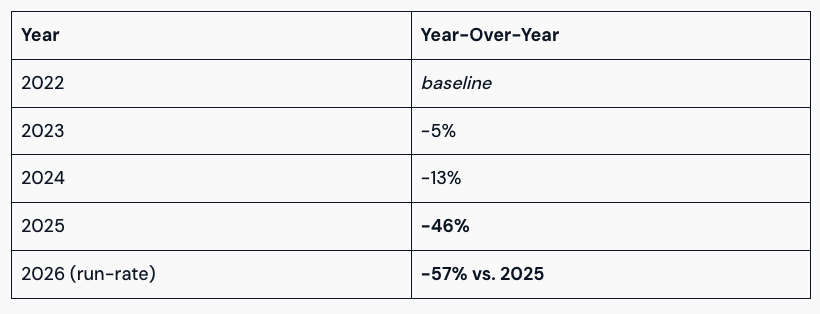
If this trajectory holds, Ferriss’s catalog will sell roughly 80% fewer print copies this year than it did in 2022. This isn’t an anomaly; across the industry, the Self-Help subcategory saw a massive 26.3% year-over-year drop in early 2026.
Ferriss’s diagnosis is starkly pragmatic: his books were fundamentally elegant decision trees and lookup tables meant to answer direct human queries (e.g., How do I lose weight? How do I automate my business?). In 2019, a 600-page book was the premier user interface for those answers. In 2026, the premier interface is a free chatbot that has ingested his books and can spit out a personalized protocol in fifteen seconds.
However, Ferriss remains uniquely unfazed. He draws a vital line between information (which is easily automated) and transformation (which requires human storytelling and sequencing to actually catalyze behavior). He predicts the market for raw information will completely collapse into chatbots, forcing human writers to pivot to a “smaller, weirder, and more interesting” premium tier supported by a tight-knit community of “1,000 True Fans” — a concept coined by Kevin Kelly.
For Ferriss, creative storytelling and fiction are the ultimate safe havens: “Voice, taste, and personality may end up being the only durable moats.”
The existential panic in fiction
If nonfiction writers are pragmatically adjusting to an interface shift, fiction writers are in a state of outright existential terror. A groundbreaking report from the University of Cambridge’s Minderoo Centre for Technology and Democracy, published in November 2025, flatly challenges Ferriss’s assumption that creative “voice” is a safe moat.
Unlike nonfiction, where the drop is driven by changing consumer habits, the crisis in fiction is fueled by systemic copyright violation, algorithmic flooding, and economic strangulation:
Data scrape: 59% of novelists know or suspect their copyrighted novels were used, without permission or payment, to train the very LLMs competing against them.
Immediate income loss: 39% of UK novelists report their income has already taken a hit.
The gig economy collapse: Because the median income for a UK author is a meager £7,000 a year, most rely on freelance copywriting or translation to survive. AI is rapidly wiping out these baseline survival gigs, effectively starving authors out of the time required to write books.
Furthermore, the Cambridge data reveals that genre fiction is incredibly vulnerable. While literary fiction is seen as safer, trope-heavy and structural genres are directly in the algorithmic crosshairs.
Novelists fear this will result in an influx of cheap, automated, formulaic books that lack what author Stephen May calls the “friction and pain” of a human first draft—resulting in a blander, homogenized literary culture.
The synthesis: a two-tiered cultural future
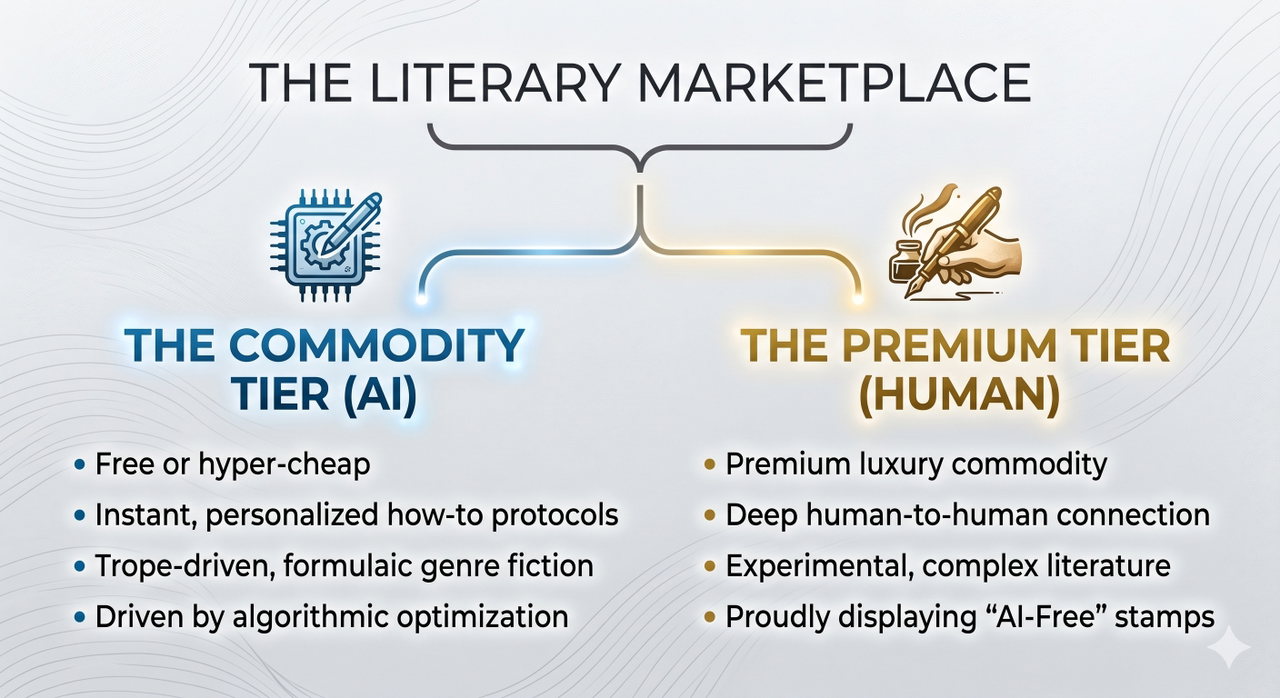
When you place Ferriss’s data side-by-side with the Cambridge report, they point to the exact same cultural destination: the birth of a two-tier creative marketplace.
To survive, independent publishers and novelists are leaning into the “hand-knitted sweater” analogy popularised by bestselling author Tracy Chevalier. If AI can produce books instantly and cheaply, humans must market their work as an artisanal luxury. Independent houses like Bluemoose Books are already preparing physical “AI-Free” stamps for their covers, betting that readers will consciously choose to support human obsession over machine efficiency.
Ultimately, both perspectives offer the same warning to creators: if your writing can be reverse-engineered, streamlined, or treated as a lookup table, the algorithm has already won. Survival in the AI era requires abandoning the mass-market numbers game entirely and double down on the messy, complex, and un-summarizable depths of the human condition.
The future of audio is two-tier
Nathan Hull on why premium productions will command premium prices